Scaling the Agentic Enterprise
Across your organization, agents are already shipping features and running operations. Early results are clear: velocity is improving. Yet as AI rolls out, deeper challenges emerge. Are you accumulating disconnected assets and data that must be unwound later? Are models specialized enough for your business functions?
Running dozens of agentic pilots does not create an agentic enterprise. Scalability depends on whether your AI advantage compounds over time. This requires moving beyond isolated experiments to a shared, governed architecture.
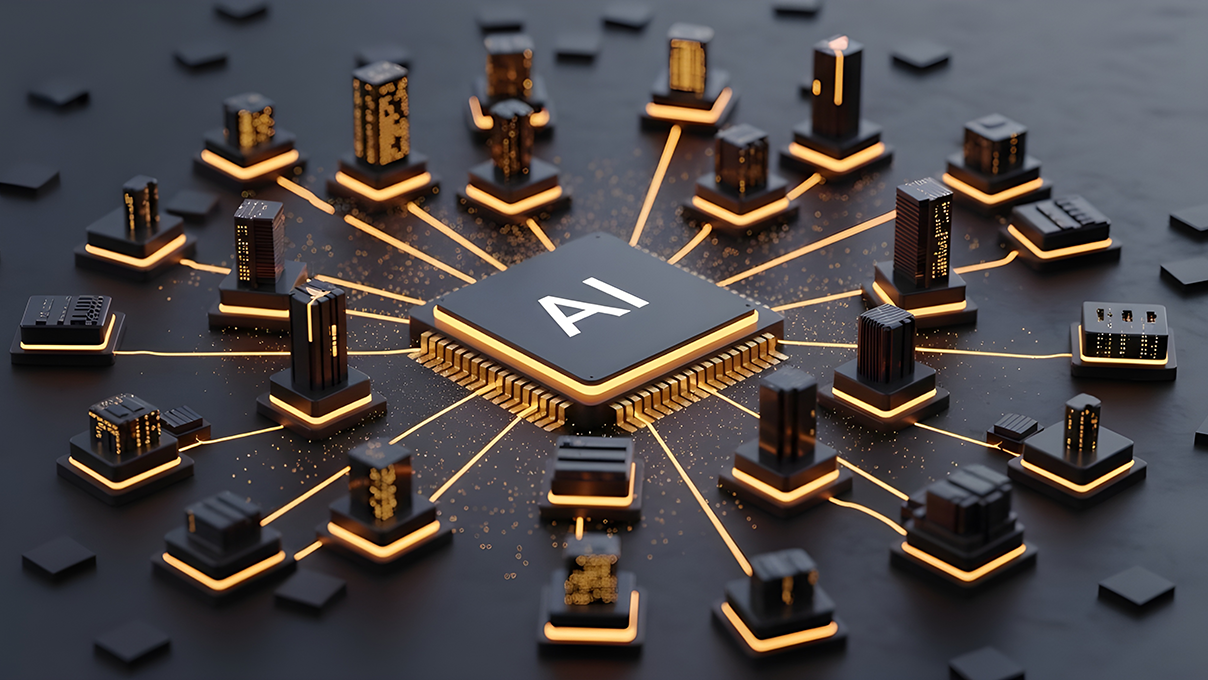
A true agentic enterprise operates on a governed system that connects modernization, product development, and AI-powered operations across four shared layers: human oversight, system ontology, verification & risk, and an agentic runtime. This architecture transforms isolated gains into compounding progress.
The difference is structural. Without a shared operating system, AI produces activity without durable progress. With it, every program builds on the last.
The larger the enterprise, the bigger the disconnect
Most enterprises fragment their AI efforts into three siloed workstreams, each operating with different leaders and tooling:
- Modernization: Updating legacy systems while redesigning data for AI consumption.
- Net-New Product Development: Fast, co-creative cycles building with AI to accelerate innovation.
- AI-Powered Operations: Governed agents running workflows that were once manual.
When these efforts remain disconnected, they lack shared context. Modernization struggles with missing knowledge, product teams treat existing systems as external constraints, and operations lack visibility into system changes. This “default” model produces local wins but misses the opportunity for shared learning.
The “default” operating model has a predictable end: local gains are produced without shared learning.
The governed operating system: four shared layers
A governed operating system makes the enterprise legible to AI and auditable to humans. It moves beyond “clever agent tricks” to a platform that optimizes for efficiency.
- Human oversight: Expert judgment where humans set policy and decide where autonomy widens or pulls back.
- System ontology: A living model of code, architecture, and domain context that stays current as systems change.
- Verification & risk: Automated tests, adversarial checks, and security gates applied to every change before production.
- Agentic runtime: The execution environment where governed agents perform modernization, development, and operations.
Work performed by agents updates the system model, informing every subsequent change. This shared learning is the residue of a disciplined operating model. When modernization, new builds, and operations run on the same foundation, the enterprise behaves as a single system where returns compound.
From three programs to one learning system
With the operating system in place, the three types of programs start to reinforce each other instead of working in isolation.
Modernization is no longer just cleanup. As legacy code is surfaced, understood, and improved, the system model sharpens, test coverage increases, and more work can be safely handled by agents in both development and operations.
Net-new product work is no longer decoupled from reality. It is grounded in actual architecture, data flows, and constraints, rather than assumptions that become integration problems later. Teams and agents design new features against the same up-to-date picture that modernization is improving.
Operations stops being a silo. Governed agents take on operational and business workflows directly. Because they run on the same operating system as modernization and new build, what they learn about how the business actually runs updates the shared view—so the next change in any program starts from real conditions, not guesswork.
At that point, you no longer have three programs and a stack of pilots. You have one system you can explain, audit, and improve as a whole.
This is what gives you a lasting advantage. Models will improve and clever agent tricks will be copied, but the operating system is not something a competitor can buy off the shelf or stand up overnight. It is the compounding accumulation of system knowledge, verification discipline, governance, and the hard‑won experience of running it—the thing that makes your entire enterprise legible to AI. It compounds because it is not a product. It is the residue of disciplined decisions made over time, on ground no competitor shares.
Choosing a governed system over a scatter of pilots is a strategic trade: trading the quick demo for the advantage that builds. While pilots feel faster initially, a shared operating system pulls ahead as learning accumulates, creating an advantage rivals cannot copy.
How 3Pillar helps you build the agentic enterprise
Making it real means building that operating system into your own environment—it is built, not bought, and few enterprises have the years it would take to assemble one from scratch. 3Pillar built HelixAI, the open platform that composes the four layers which are customized to your rules, budget requirements, and metrics, and deployed to the environment of your choice.
Two things set HelixAI apart: it is open and model‑agnostic, so your operating system outlives whatever model leads this quarter; and it is composable, so you start where the pain is sharpest and expand without rebuilding. The decision is no longer which agent framework to back—it is whether the next year of AI investment compounds into one governed system, or scatters into another stack of pilots.
Each layer has a name in HelixAI, and—as in the system itself—the human layer comes first.
Helix Pods powers the human layer. 3Pillar experts work alongside agents and your team to provide the essential judgment and governance that AI alone cannot provide.
ATLAS serves as the system ontology. It maintains the living model of your enterprise, ensuring every system dependency and process is legible to agents.
AIRE provides the verification & risk layer. It ensures that every code change or operational update clears strict security and quality gates before deployment.
NEXUS acts as the agentic runtime. This is where governed execution happens, feeding results back into the system model so the entire enterprise improves together.
Together they behave as one system, and each layer feeds the others, so it sharpens the more work runs through it.
We’re proving it now. Across 3Pillar engagements, we’re seeing developer productivity increases of 2x and throughput gains of 2–5x, and modernization delivery speeds improve by 15–50%. HelixAI benchmarking demonstrates a 60% reduction in token usage and a 50% reduction in response time for complex queries compared to native models. See how this works on a live modernization program.
You don’t have to make this decision in a vacuum. 3Pillar can assess where your AI work stands today across modernization, product, and operations, and define a path to a single governed operating system in your environment. Let’s build it together.
About the author