

Altitude not attitude. Getting to AI conviction faster.
Contributing Author — Andy McKinney
Private equity portfolio companies have invested heavily in AI, yet late in 2026, many still struggle to demonstrate a clear return on investment. It’s time to rethink the altitude from which AI strategy is originated and investment conviction is established.
AI investments in PE portfolios have been bifurcated. POC’s and point solutions coming from the bottom up, and broad transformation plans coming from the top down. Both have proven insufficient to delivering measurable business outcomes.
Portfolio companies starting with POCs were simply dipping their toes in the technology. AI initiatives were launched with good intentions (“this is a pain point; let’s see if AI can help”), but with far too little forethought in how to scale this across the org. The logic here was driven by the PoC concept itself: build the concept, prove value on a micro-scale, then attempt to scale. But the last phase is elusive, because results have been challenging to accurately anticipate, and ultimately different every time.
The top down transformation approach also has good intentions, but it falls apart in execution. Portco’s have to run their businesses while also trying to transform, and when capacity becomes the constraint (which it always does) the near term requirements of the business always take precedent.
In other words, value delayed, value denied.
As private equity hold windows continue to extend, every month spent waiting on returns is a drag against against fund performance.
With those longer hold periods limiting reinvestment frequency, operating teams cannot afford drawn-out validation cycles. Yet, teams continue to spend months determining where to place their bets, running disconnected experiments that stumble due to misalignment, or waiting on lagging financial metrics before scaling. In a post-ZIRP environment, this delay imposes a real, compounding cost.
So what do we do about this? Operating partners must reach conviction on the right AI investments for each portfolio company faster. That requires prioritizing bets backed by org-specific data, targeting ‘safe’ market-proven value domains, and executing with high confidence that returns can be scaled rapidly across the enterprise.
Said plainly, there are obvious ways to gain measurable value from AI. In most cases, AI creates the most meaningful enterprise value on three fronts, with increasing complexity in order:
- Preparing an organization’s core software to gain from what comes next
- Changing how the organization fundamentally operates
- Evolving customer experience with more intelligent, personal interactions
All three matter. But for most PE operating partners looking across a portfolio, the first two typically provide the most direct levers for systematic value creation now.
This article focuses there.
AI strategy must start at the right altitude
The programs that worry me are pitched at one of two altitudes, each with its own failure mode for typical PortCo AI adoption.
At the top, strategy goes atmospheric. Leadership sets the broad mandate for AI transformation, often with real capital behind it, but the plan stays well above the details of how the company actually creates value. Instinct vs. data-driven. The ambition is usually sound, and the gap opens when someone has to translate lofty vision, even one pointed at certain domains, into actual change. These wholesale transformations imply operational disruption few organizations have priced in or taken enough input on.
The more common failure sits lower down. One team automates some task, another adopts their favorite coding assistant, product launches a chat agent, operations rewrites a workflow they’re pained by. Each effort can be useful on its own and still produce nothing at the enterprise level.
Consider an engineering team that doubles throughput with AI-assisted development while QA capacity and release calendars stay exactly the same. The extra output queues up, sure, but the customer sees the same release cadence. Engineering velocity improves but organizational performance doesn’t capture the value.
The level that works is the middle ground.
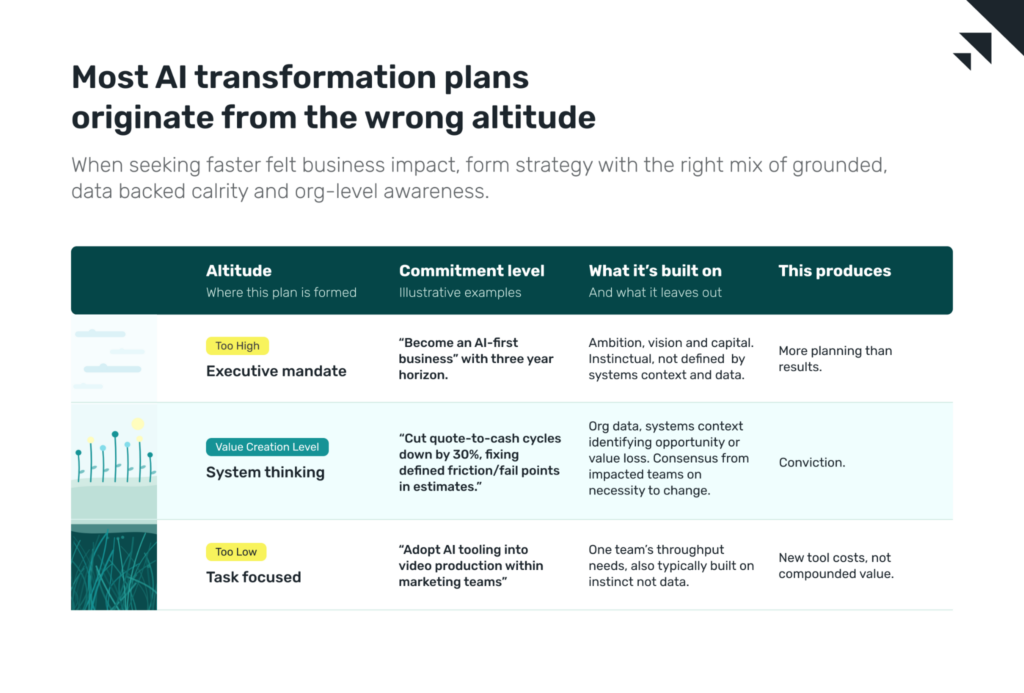
A plan built from this middle altitude is concrete enough for teams to act on while declaring expected impact. More importantly and in our experience, that plan’s defensible, because it was prioritized against intelligence on the company’s own enterprise data, with functional and product leader consensus behind it. The business has conviction in the investment walking in.
It’s an approach that’s less “proof of concept” and more “we just need to do this, and we understand how it will improve our business.”
Priority #1: Get the software estate fully ready for AI
…and eliminate significant legacy management debt and opportunity cost in the meantime.
KEY POINTS
- Fund it first. This is squarely an AI-driven program and it’s work that pays even if a particular AI thesis is wrong. The PortCo’s estate gets cheaper to maintain, future integrations get easier, and the engineering velocity improves for whatever projects come next.
- Context before code. The first job for AI inside your software is to read it, not to change it. What you are building is a living context layer, and every agent, roadmap and modernization decision downstream runs off it.
- The investment evidence is already in-house. Code, architecture, dependency graphs, incident history, product telemetry. Where business dependence and cost-to-change make sense together is where the investments should initially focus.
- Working altitude. Not a multiyear classical “modernization” program, and not a tooling rollout. Start from a named domain, rank debt against outcomes the business already tracks, and treat modernization as one output of the work rather than the point of it.
The big idea is simple. Jet engines are designed for jet fuel. AI and coding agents are the new fuel for software delivery, and most core software was built for what came before them (the agents). The side benefit of getting an estate into a state those agents can work in is an estate that costs materially less to run: for some organizations that has meant 40%+ in maintenance cost savings.
Where teams can go wrong as they consider this priority space, is treating the AI-initiative as purely the pursuit of a modernization backlog with AI bolted onto it. When thinking of an overall AI adoption strategy within a software or software-driven-services org, a more useful sequence runs across five phases.
- Build the context layer and keep it current. Leverage AI tooling to first build a context layer (knowledge graph that can be queried and integrated into engineering work) that becomes the single source of truth for all agentic engineering that follows, exactly because it fully understands your software ecosystem. Dependencies, business logic, code, data, integrations, and more – and it has to move as the software moves. A stale map is worse than none, because people trust it.
- Turn technical debt into a ranked investment list. Use AI in combination with human team insights to find the opportunities and score each item against a business outcome: velocity in the product area under competitive pressure, decreasing cost to serve, or the ability to ship AI features at all. Debt stops being a murky list of possible focus areas to clean up and becomes defensible investments that can be sequenced.
- Prepare the estate for agentic change. Test coverage and CI that catch what an agent breaks, module boundaries that keep blast radius small, and a policy for which changes an agent may make without a human.
- Sequence the work and execute it in the new model. Start where competitive threat and technical debt overlap, and do the work with AI-assisted engineering so the work itself builds the capability. Measure cycle time, change failure rate, and the share of changes that are agent-authored.
IN PRACTICE
An incumbent software company came to us with significant technical debt, new entrants disrupting the core experience in its market, and a need to get back on the front foot in product innovation.
Using Helix, we assessed the architecture, codebase, data and major interdependencies in under a week. That produced an intelligent interface into the software estate and the evidence for a roadmap: what to address first, how to sequence it, and the expected sizing and timeline. The board approved it as the company’s plan.
Priority #2: Evolve core value streams effectively, with AI
…where business economics actually improves, and where siloed adoption most often fails.
KEY POINTS
- Worth more but also typically harder. Estate work protects the company and buys optionality. Workflow transformation is what moves revenue, cost to serve and customer retention.
- Function boundaries are the obstacle. Organizations are built by function while customer value crosses them, which is how a company ends up with a portfolio of successful pilots and an unchanged P&L.
- The metric already exists. Quote-to-cash, lead-to-renewal, ticket-to-resolution. There’s no real new measure to invent, only an honest reading of where work is being held up or inefficiently run, and people tend to understand this.
- Working altitude. Take the middle path. Be big-picture enough to focus on the ecosystem surrounding any one workstream and what dependencies must be navigated to effectively transform, while precisely focused enough to actually realize measurable change.
Workflow transformation mirrors our first priority in terms of data-driven focus and leading with conviction, but with the human role weighted differently. Operational data certainly informs the first pass during prioritization, because it shows where work actually queues rather than where the process documentation says it should. But a value stream lives in judgment, exceptions and informal workarounds that no analytics or logging alone really captures. So the people who own each handoff have to be in the room to form a real plan, and this often takes time.
Workshops have a place here in a way that they don’t in a codebase assessment like that discussed above
The work runs in five steps.
- Pick one value stream with measurable success criteria. Quote-to-cash, lead-to-renewal, idea-to-release, ticket-to-resolution are good examples: each has an outcome the business already measures and a chain of teams behind it + people who definitely own parts of the operation.
- Map it with those people who own each part. Where the handoffs are, which decisions wait, and where information is lost between systems that were never designed to talk.
- Decide what the agent does and what a person decides, in the ideal target state. Name the tasks to automate, the decisions to support, and the points where a person stays accountable. That choice shapes the design more than the choice of model or tool.
- Change the operating model around it. Decision rights, measures, roles, and incentives have to move with the workflow. This is the step function-by-function rollouts skip, and the reason their gains stay local.
- Deploy close to the work and run a 60 to 90 day loop. A team that sits alongside the operation and adjusts as evidence returns shortens the distance between strategy and implementation. Measure end-to-end throughput, cost, and customer outcome; team-level productivity is a leading indicator at best.
IN PRACTICE
Through 3Pillar’s Helix Forward model, we put consulting and engineering capability directly alongside the teams that own the workstream. Our automation engineers find where agentic automation can evolve value delivery, deploy the change, and monitor performance and adoption to continue influencing that performance.
The objective here is to build AI-first operations reps fast enough that the organization’s point of view evolves progressively with each one.
Both priorities share a discipline. Each starts by making the system legible, each defines its evidence before the build, and each ends in a decision about the next investment.
Get earlier wins: start with the test that already exists
My colleague Lindsay Kloepping, who leads Helix Forward, wrote a recent piece about our short test for determining whether an AI-enabled change will have the expected impact once it’s built. She asks five questions, and an operating team should be able to answer all five before meaningful money moves.
- What outcome must improve?
- What sits upstream and downstream, and what happens to it?
- What work should be removed, redesigned, or deliberately kept?
- Who has the authority to authorize the changes the business case depends on?
- Who has to work differently, and what will make the new way stick?
Their value at the correct investment altitude is that they are answerable before the build, and that an incomplete answer is itself the finding.
Some proposals that cannot name who approves the change it depends on do not need more engineering scoping. It needs a conversation between two executives, which is far cheaper to discover in week one than in month six. The piece works through each question in depth and is worth the read for anyone about to sponsor this kind of work.
In PE, an operating partner adds only the comparison the portfolio forces: why this opportunity rather than another competing for the same capital and the same scarce people, what we should see early if the thesis is right, and what decision that evidence will allow.
Over time discipline, here, pays at the portfolio level. An operating partner starts to see which classes of investment reliably generate useful evidence, which dependencies slow adoption, which operational measures lead to customer value, and where teams consistently underestimate the change required.
Find the advantage in a shorter path to conviction
AI will keep changing fast enough that some level of uncertainty has to be accepted. Waiting for a fully known business case can consume as much value as an imperfect investment. Fortunately, PE firms and their operating partners are pretty used to those kinds of dynamics.
To see more value, chase better conviction earlier and in smarter, more informed, increments.
If you’re interested in exploring this opportunity further with a platform-driven team who knows the PE space well, we’d love to hear from you.


Innovative. Inspired. Invested.
Our AI experts and Innovation Lab team members have the kind of hands-on, real-world experience developing AI solutions that will ensure your team’s chances of success.
Let's talk